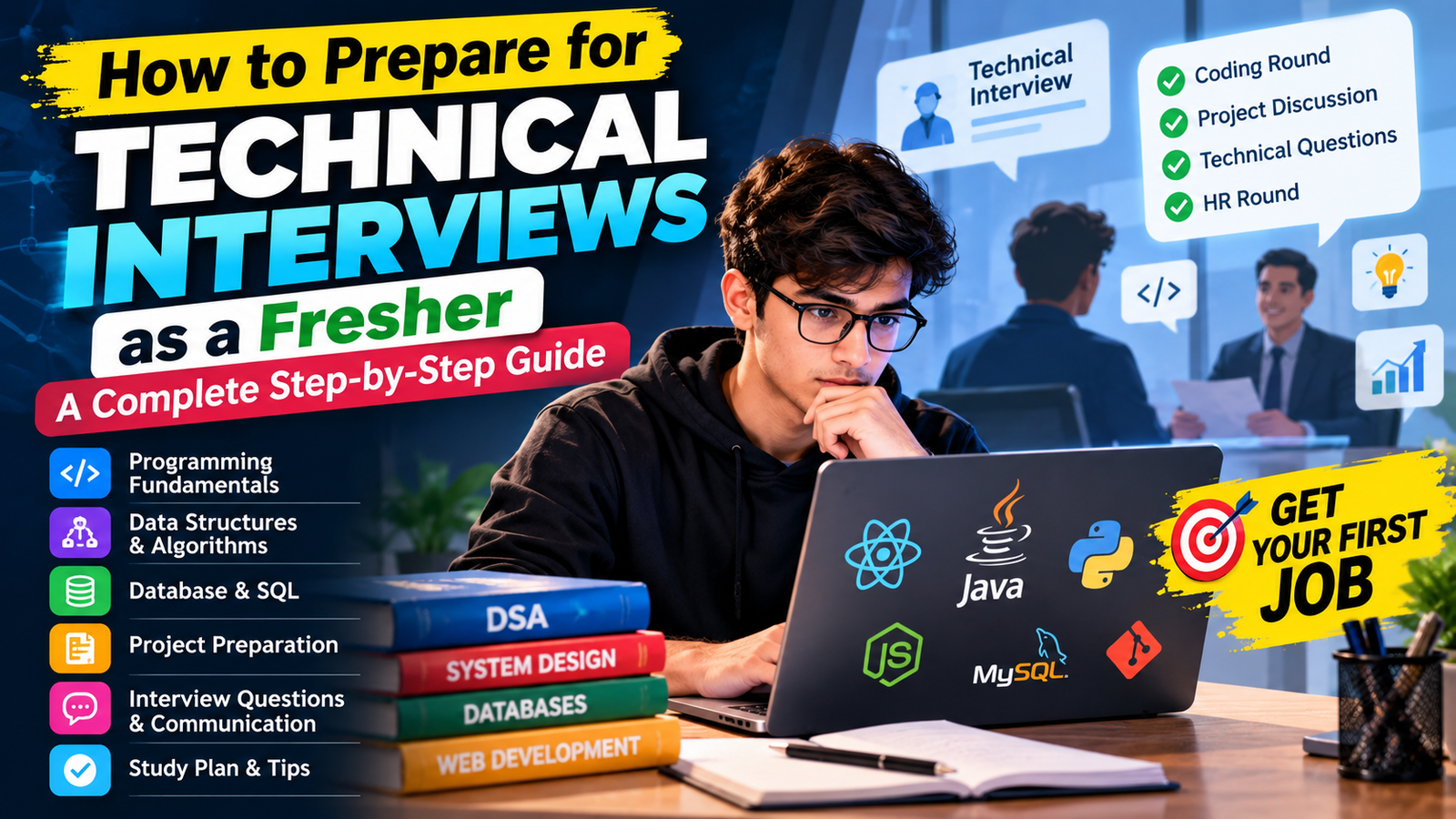
However, as a fresher, it is challenging to prepare for the Python AI/ML interview. The interview process may include both a coding round and questions on various concepts of machine learning. To prepare good basics for the interview process for the role of a Python AI/ML fresher, here are 12 questions that you all must be aware of:
Section I : Python & Data Structures
1. Difference between List, Tuple, Set and Dictionary in Python
Ans:- List is ordered and mutable, tuple is ordered and immutable, set stores unique and unordered elements, and dictionary stores elements in key-value format.
2. So why is a numpy array faster than a python list?
Ans:- NumPy arrays are faster than a Python list because they use contiguous memory storage for numerical computation.
3. Decorators and Generators in Python: What are they?
Ans:- Decorators are a feature of Python where you can modify functions and methods without actually changing them, and generators return one item at a time rather than returning all of them at one time.
4. How to handle missing values in a data set?
Ans:- The most common way is to impute the mean or median, or to use "forward fill," "interpolate," or even "predict" the missing values using machine learning algorithms.
Section II : Core Machine Learning Concepts
5. What is the difference between Supervised, Unsupervised, and Reinforcement Learning?
Ans:- Supervised learning is based on data, unsupervised learning is based on patterns, and reinforcement learning is based on rewards and punishment.
6. What is the difference between Classification and Regression?
Ans:- Classification is used for categorical outcomes, and regression is used for numerical outcomes.
7. How do you handle an imbalanced dataset?
Ans:- SMOTE, Oversampling, Undersampling, and using class weights are some common techniques that we use to handle imbalanced dataset.
8. Why is accuracy a poor metric for imbalanced datasets?
Ans:- Accuracy is not a good metric in imbalanced data sets, and Precision, Recall, and F1-score are better evaluation metrics.
Section II : Model Logic & Decision Making
9. What are some possible reasons for choosing XGBoost over Gradient Descent Models?
Ans:- XGBoost is generally preferred for structured or tabular data because it provides high accuracy, takes care of missing values on its own, and also provides regularization techniques that help avoid overfitting.
10. Why is feature scaling necessary for KNN and SVM?
Ans:- KNN and SVM need feature scaling because they use distance calculations and large feature values can affect these calculations.
11. What is Overfitting?
Ans:- Overfitting is when a model is highly accurate on training data but underperforms on unseen data.
12. How would you justify the model you have used for your project?
Ans:- You would need to justify the model based on its performance and its suitability for the problem.
12 Common Interview Questions for Python AI/ML Fresher

💼 Ready to Find Your Dream Job?
Browse verified fresher jobs and internships — updated daily.
Browse Latest Jobs →