
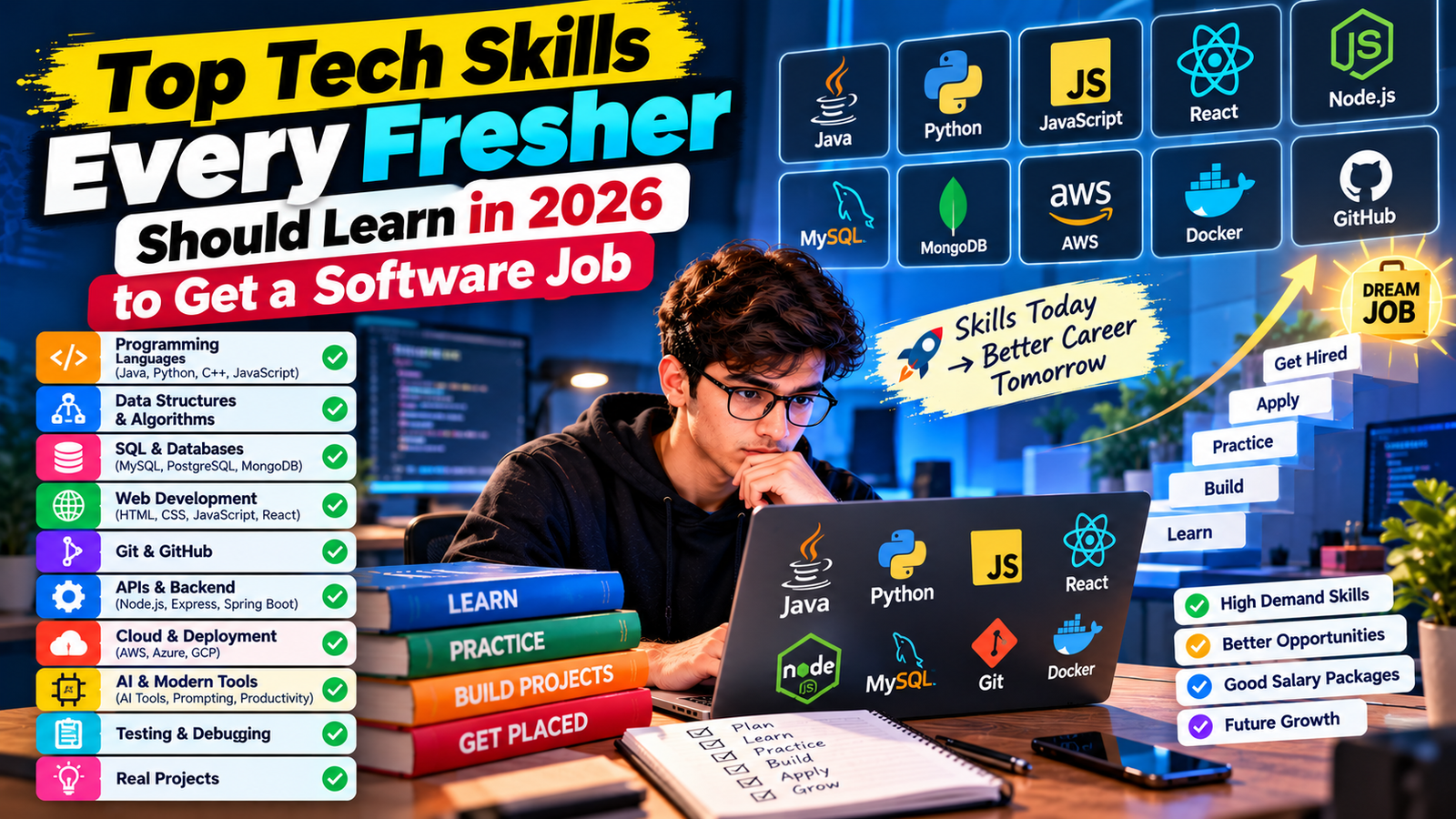
Top Tech Skills Every Fresher Should Learn in 2026 to Get a Software Job
The technology industry is constantly changing, and freshers often face one major question: Which technical skills should I learn to get a software job? There are hundreds of programming languages, frameworks, tools, and technologies available, but learning everything is neither practical nor necessary.
The better approach is to build strong fundamentals first and then develop job-ready skills based on the role you want to pursue. Here are some of the most useful technical skills that freshers should consider developing.
1. Learn One Programming Language Properly
The first step toward becoming a software developer is learning one programming language deeply.
Java, Python, C++, and JavaScript are popular choices. Focus on variables, loops, functions, arrays, strings, object-oriented programming, exception handling, and basic problem-solving.
You do not need to learn five programming languages at the beginning. A strong understanding of one language is more valuable than superficial knowledge of several languages.
2. Master Data Structures and Algorithms
Data Structures and Algorithms are important for many software engineering roles and coding assessments.
Start with arrays, strings, linked lists, stacks, queues, hash maps, recursion, sorting, and searching. After building confidence, move toward trees, graphs, dynamic programming, and other advanced topics.
The goal should not be memorizing solutions. Understand how and why an algorithm works and learn to identify the right approach for a new problem.
3. Build Strong SQL and Database Knowledge
Almost every modern application works with data, making database knowledge valuable for developers.
Learn SQL commands such as SELECT, INSERT, UPDATE, DELETE, JOIN, GROUP BY, ORDER BY, and aggregate functions. Also understand primary keys, foreign keys, indexes, normalization, and basic database design.
MySQL and PostgreSQL are good databases to practice with, while MongoDB can be useful when learning NoSQL concepts.
4. Learn Web Development Fundamentals
If you are interested in software or web development, start with HTML, CSS, and JavaScript.
Understand how websites work, how browsers communicate with servers, HTTP methods, APIs, forms, responsive design, and basic authentication.
Once your JavaScript fundamentals are strong, you can learn frameworks such as React for frontend development and technologies such as Node.js and Express for backend development.
5. Understand Git and GitHub
Git is an essential tool for modern software development.
Learn how to create repositories, commit changes, create branches, merge code, resolve conflicts, pull changes, and work with remote repositories.
Maintaining projects on GitHub can also help recruiters and interviewers understand your practical development experience.
6. Learn APIs and Backend Fundamentals
Even if you want to become a frontend developer, understanding how APIs work can make you a stronger developer.
Learn REST APIs, HTTP methods such as GET, POST, PUT, and DELETE, status codes, JSON, authentication, and how frontend applications communicate with backend services.
For backend development, you can explore technologies such as Node.js, Java Spring Boot, Python Flask, or Django depending on your career path.
7. Develop Cloud and Deployment Knowledge
Knowing how to deploy an application is a valuable practical skill.
Start with basic concepts such as servers, hosting, domains, databases, environment variables, and deployment pipelines. Then explore cloud platforms such as AWS, Microsoft Azure, or Google Cloud.
You do not need to become a cloud expert immediately. Understanding how a project moves from local development to a production environment is already a useful skill for a fresher.
8. Learn Basic AI and Modern Development Tools
Artificial intelligence is becoming part of many software development workflows.
Freshers do not necessarily need to become AI researchers, but understanding basic AI concepts and learning how modern AI tools can assist with coding, debugging, documentation, and productivity can be useful.
For developers interested in AI, Python, APIs, machine learning fundamentals, and working with AI services can be good starting points.
9. Learn Testing and Debugging
Writing code is only one part of software development. Developers also need to identify and fix problems.
Learn how to read error messages, use debugging tools, write basic tests, and identify the root cause of common issues.
Understanding testing concepts such as unit testing, integration testing, and API testing can make your development skills more complete.
10. Build Real Projects
Technology skills become much more valuable when you can apply them.
Instead of completing courses continuously without building anything, create practical projects. For example, you can build an e-commerce application, task management system, job portal, student management system, expense tracker, or AI-powered application.
Projects help you understand how different technologies work together and give you valuable experience to discuss during interviews.
11. Choose Skills According to Your Target Role
You do not need to learn every technology mentioned above.
For example:
Frontend Developer: HTML, CSS, JavaScript, React, Git, APIs
Backend Developer: Java/Python/Node.js, APIs, databases, Git
MERN Developer: MongoDB, Express, React, Node.js, JavaScript
Data Analyst: Python, SQL, Excel, data visualization, statistics
Cloud/DevOps: Linux, Git, Docker, cloud platforms, CI/CD
AI/ML: Python, statistics, machine learning, data handling, AI tools
Choosing skills according to your target role prevents unnecessary learning and helps you build a stronger profile.
Conclusion
For freshers, becoming job-ready is not about collecting a long list of technologies. The most effective approach is to build strong programming fundamentals, learn the tools required for your target role, and apply your knowledge through real projects.
Start with one programming language, strengthen DSA and SQL, learn Git and APIs, develop role-specific skills, and gradually explore cloud or AI technologies. Most importantly, keep building and practicing.
Strong fundamentals + practical projects + consistent learning = a much stronger technical profile for your first job.
Top Tech Skills Every Fresher Should Learn in 2026 to Get a Software Job
💼 Ready to Find Your Dream Job?
Browse verified fresher jobs and internships — updated daily.
Browse Latest Jobs →