
Everyone is talking about AI taking jobs. But here is what nobody tells you — AI is also creating hundreds of thousands of new jobs, and a large chunk of them do not require you to write a single line of code.
You do not need a computer science degree. You do not need to know Python or machine learning. What you need is curiosity, communication skills, and the willingness to learn how AI tools work at a basic level.
If you are a fresher, an arts or commerce graduate, or someone from a non-technical background wondering how to get into the AI industry — this blog is exactly for you.
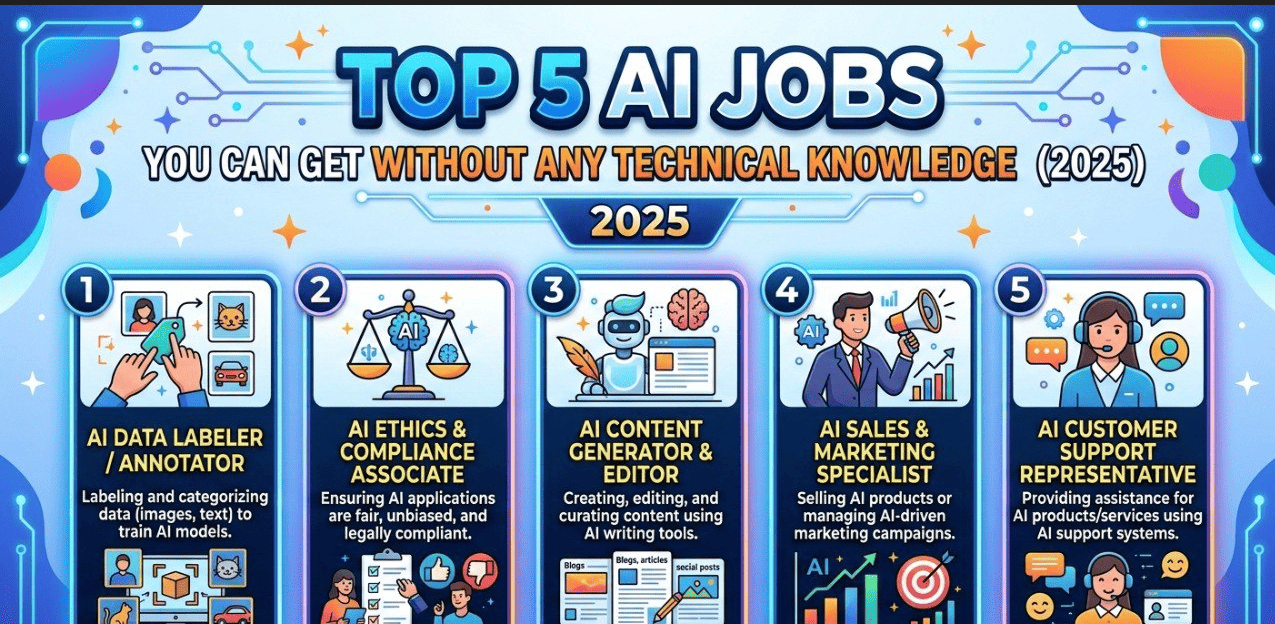
Here are the top 5 AI jobs you can land without any technical knowledge in 2025.
1. AI Prompt Engineer
This is probably the hottest non-technical AI job right now. A prompt engineer's job is to write, test, and refine the instructions given to AI tools like ChatGPT, Gemini, Claude, and others to get the best possible output.
Think of it like this — AI is a very powerful employee, but it needs very specific instructions to do its job well. A prompt engineer is the person who figures out exactly how to give those instructions.
What you need:
You need strong written communication skills, logical thinking, and the ability to experiment. No coding required. Most companies train you on the AI tools they use.
Where to find these jobs:
Search for "Prompt Engineer", "AI Content Specialist", or "Generative AI Analyst" on LinkedIn, Naukri, and Internshala. Startups in the US and India are actively hiring for this role.
Salary range in India: ₹4 LPA to ₹15 LPA depending on experience and company size.
2. AI Data Annotator / Data Labeler
Every AI model learns from data. But before that data can be used to train an AI, a human being has to label it, categorize it, and verify it. That human is a data annotator.
For example — if a company is building an AI that detects emotions in photos, someone has to go through thousands of images and tag each one as "happy", "sad", "angry", and so on. That someone is you.
What you need:
Attention to detail, patience, and basic computer skills. That is it. No technical background required. Most companies provide a short training before you start.
Who is hiring:
Amazon Mechanical Turk, Scale AI, Appen, Telus International, iMerit, and dozens of Indian BPO companies now have entire AI data annotation divisions. Infosys, Wipro, and TCS also have annotation projects.
Salary range in India: ₹2.5 LPA to ₹6 LPA for entry level. Senior annotators and quality checkers earn more.
This is genuinely one of the easiest ways to get your foot in the door of the AI industry.
3. AI Content Writer / AI Content Strategist
Companies building AI products need people who can explain what those products do — in simple, clear, human language. They need blog writers, social media managers, product description writers, and content strategists who understand AI tools and can write about them effectively.
This is different from a regular content writing job. Here, you are expected to use AI tools yourself to assist your writing, understand what makes AI content useful versus generic, and help the company communicate its AI product to a non-technical audience.
What you need:
Good writing skills, basic understanding of what AI tools like ChatGPT and Midjourney do, and the ability to write clearly for different audiences. If you are already using AI tools in your daily life, you are ahead of most candidates.
Who is hiring:
AI startups, SaaS companies, edtech platforms, and marketing agencies are all hiring for this. Look for job titles like "AI Content Writer", "Tech Content Strategist", "AI Marketing Associate".
Salary range in India: ₹3 LPA to ₹10 LPA. Freelancers can earn significantly more per project.
4. AI Product Tester / QA Analyst
Before any AI product goes live to millions of users, someone has to test it. They have to use it in hundreds of different ways, find where it gives wrong answers, where it behaves unexpectedly, and report these issues clearly to the development team.
This is called AI Quality Assurance or AI Red Teaming in more advanced roles. You are essentially stress-testing an AI product.
What you need:
A curious mindset, the ability to think like someone who wants to break things, strong observation skills, and clear written communication to document what you find. You do not need to understand how the AI was built — you just need to use it thoroughly and report issues clearly.
Who is hiring:
Every company building an AI product needs testers. This includes large tech companies, AI startups, and product companies that are adding AI features to their existing software.
Salary range in India: ₹3 LPA to ₹8 LPA for entry level QA roles with AI focus.
5. AI Ethics and Policy Analyst
This is the most underrated AI job on this list. As AI becomes more powerful, governments, companies, and organizations need people who can think about the ethical, legal, and social implications of AI decisions.
Should an AI be allowed to make hiring decisions? What happens when an AI is biased against a certain group of people? How should AI-generated content be regulated? These are not technical questions — they are human questions.
Companies, think tanks, policy organizations, and even government bodies are hiring people to think about these questions professionally.
What you need:
A background in law, political science, philosophy, sociology, economics, or even journalism is highly valued here. You need strong critical thinking, research skills, and the ability to write clear policy documents or reports.
Who is hiring:
Google, Microsoft, Meta, and almost every large tech company now has an AI Ethics team. In India, policy organizations, law firms, and government departments working on digital regulation are also building these teams.
Salary range in India: ₹5 LPA to ₹18 LPA. This field is growing fast and salaries are rising quickly.
How to Get Started Right Now
You do not need to wait until you have years of experience. Here are three things you can do this week to start building your profile for these roles.
First, start using AI tools daily. Use ChatGPT, Gemini, Claude, Midjourney, and other tools. The more comfortable you are with them, the more confident you will be in interviews.
Second, take one free course. Google, Microsoft, and LinkedIn all offer free AI literacy courses that take less than 10 hours to complete and give you a certificate you can add to your resume and LinkedIn profile.
Third, apply even if you do not feel ready. Most companies hiring for these roles are not expecting you to be an expert. They are looking for people who are curious, adaptable, and willing to learn. Your attitude matters more than your experience at this stage.
Final Thought
The AI revolution is not just for engineers and data scientists. It is for communicators, thinkers, testers, writers, and problem solvers of all kinds. The question is not whether AI will create opportunities for non-technical people — it already is. The question is whether you will be ready to grab them.
Start exploring. Start applying. The best time to get into AI was two years ago. The second best time is right now.
If you are looking for AI and tech-adjacent job openings for freshers, check the latest listings on Jobdexo — updated daily with verified off-campus opportunities.
Top 5 AI Jobs You Can Get Without Any Technical Knowledge (2025)
💼 Ready to Find Your Dream Job?
Browse verified fresher jobs and internships — updated daily.
Browse Latest Jobs →