
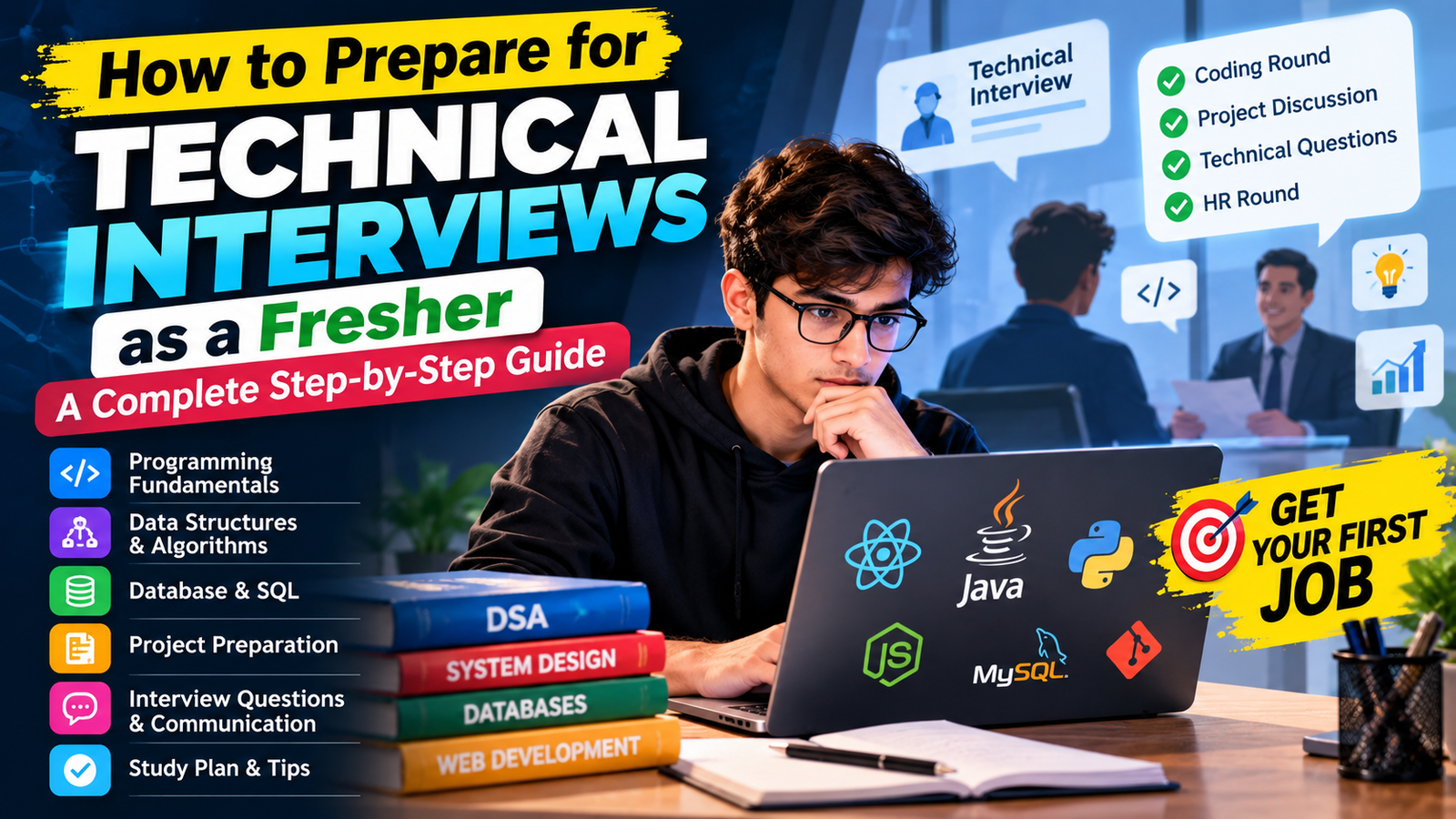
How to Prepare for Technical Interviews as a Fresher: A Complete Step-by-Step Guide
Getting your first software development job as a fresher can be challenging, especially when you are not sure what companies expect during technical interviews. The good news is that technical interview preparation becomes much easier when you follow a structured approach. Instead of trying to learn everything at once, focus on building strong fundamentals, solving practical problems, and improving your communication.
1. Understand the Interview Process
Before starting your preparation, understand the type of hiring process followed by the companies you are targeting. Many fresher hiring processes include an aptitude or online assessment, coding round, technical interview, project discussion, and HR or managerial round.
Knowing the process helps you divide your preparation time properly. For example, if a company focuses heavily on coding, you should spend more time practicing programming and problem-solving questions.
2. Strengthen Your Programming Fundamentals
Choose one primary programming language and become comfortable with it. Java, Python, C++, and JavaScript are commonly used in software development interviews.
Focus on variables, loops, functions, arrays, strings, object-oriented programming, exception handling, collections, and basic input/output operations. You should be able to explain your code instead of simply memorizing solutions.
For Java interviews, topics such as OOP, Collections, Exception Handling, Multithreading basics, and Java 8 features can be particularly useful.
3. Practice Data Structures and Algorithms
Data Structures and Algorithms are important for many technical interviews. Start with arrays and strings before moving to linked lists, stacks, queues, hash maps, trees, graphs, recursion, sorting, and searching.
Do not focus only on solving hundreds of questions. Try to understand the logic behind every solution. After solving a problem, ask yourself why your approach works and whether there is a more efficient solution.
4. Prepare Your Projects Properly
Your projects can become one of the most important parts of a fresher interview. Be prepared to explain the project from beginning to end.
Know your project's technology stack, database structure, APIs, authentication process, major features, challenges, and deployment process. Interviewers may also ask why you selected a particular technology or how you would improve the project.
Avoid adding technologies to your resume that you cannot explain during an interview.
5. Revise Database and Web Development Concepts
For software developer roles, revise SQL, database concepts, REST APIs, HTTP methods, authentication, Git, and basic frontend or backend concepts.
Practice writing SQL queries involving SELECT, JOIN, GROUP BY, ORDER BY, subqueries, and aggregate functions. If you are applying for frontend roles, also revise HTML, CSS, JavaScript, React, and browser fundamentals.
6. Practice Explaining Your Answers
Technical knowledge alone is not enough. During an interview, explain your thought process clearly.
If you do not know an answer, avoid making up information. You can explain what you know and honestly mention that you would need to research the remaining part.
Practice mock interviews with friends or by speaking your answers aloud. This can improve confidence and reduce hesitation.
7. Follow a Consistent Preparation Routine
A simple daily routine can make preparation more manageable. Spend time on coding practice, technical concepts, project revision, and interview questions every day.
For example, you can solve two or three coding problems, revise one technical topic, and spend 20–30 minutes explaining your projects or practicing interview questions.
Conclusion
Preparing for a technical interview as a fresher is not about learning every technology available. It is about building strong fundamentals, practicing problem-solving, understanding your projects, and communicating your knowledge clearly.
Start with one programming language, strengthen DSA and core concepts, prepare your projects thoroughly, and practice consistently. With structured preparation and regular practice, you can approach technical interviews with a much clearer understanding of what to expect.
How to Prepare for Technical Interviews as a Fresher: A Complete Step-by-Step Guide
💼 Ready to Find Your Dream Job?
Browse verified fresher jobs and internships — updated daily.
Browse Latest Jobs →