Complete Placement Guide for Freshers: How to Prepare for Campus Placements and Get Your First Job
Campus placements can be an important opportunity for college students to start their professional careers. However, getting placed is not only about having good academic marks. Companies generally evaluate candidates through multiple stages such as aptitude tests, coding assessments, technical interviews, project discussions, and HR rounds.
With a proper preparation strategy, students can approach the placement season with more confidence and improve their chances of getting selected.
1. Understand the Placement Process
Before starting preparation, understand the different stages commonly included in campus placements.
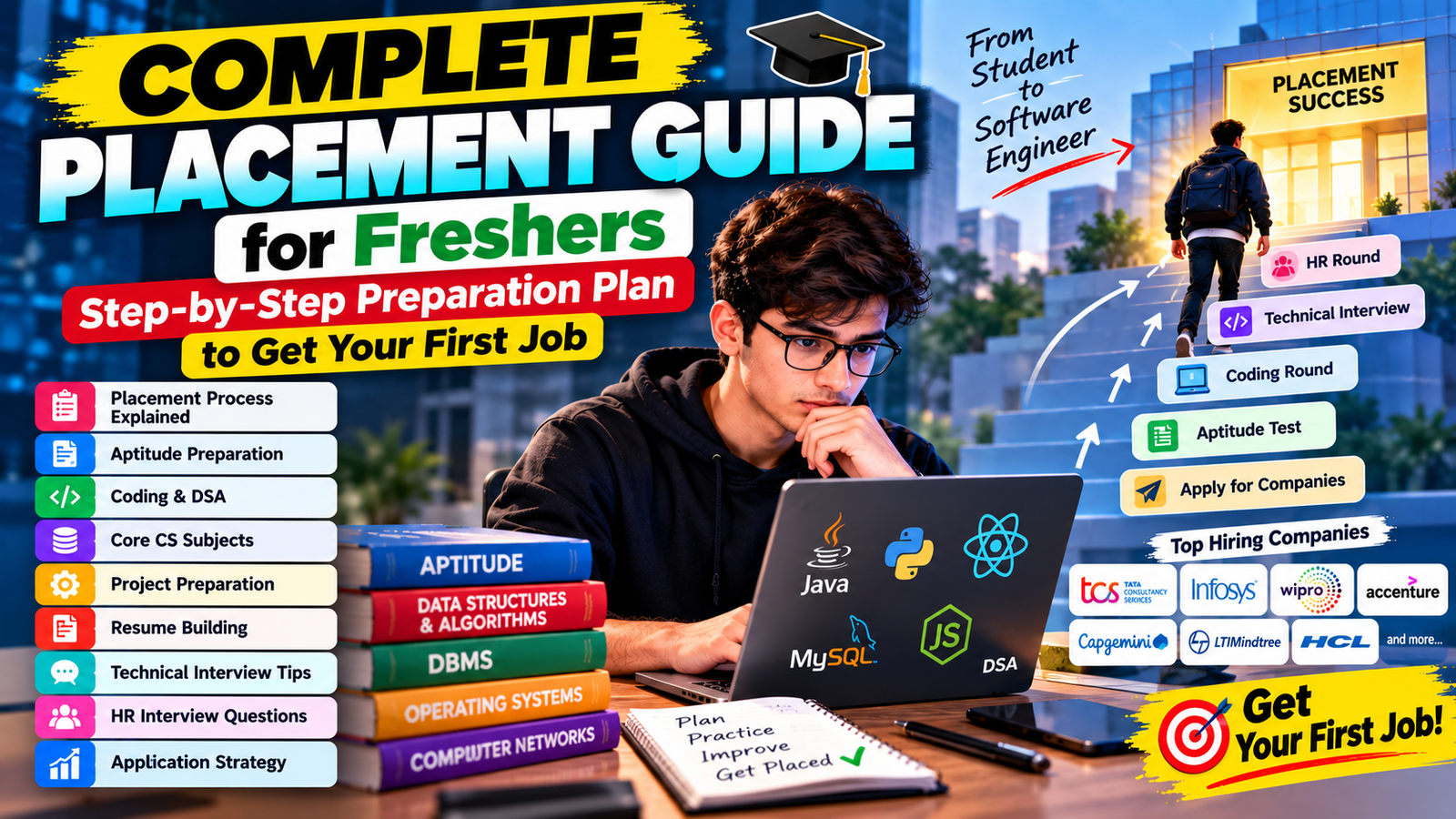
A typical hiring process may include an aptitude or online assessment, coding round, technical interview, managerial or technical discussion, and HR interview. Some companies may also include group discussions, communication tests, or additional assessments.
Understanding the process helps you prepare for each stage instead of focusing only on coding or interviews.
2. Check Your Eligibility Carefully
Different companies have different eligibility criteria. Before applying, check requirements such as graduation year, percentage or CGPA, backlogs, degree branch, experience requirements, and required technical skills.
Do not ignore eligibility conditions because clearing an assessment does not guarantee selection if you do not meet the company's basic requirements.
3. Build Strong Aptitude Skills
Aptitude tests are commonly used during fresher hiring. Important areas include quantitative aptitude, logical reasoning, verbal ability, data interpretation, and sometimes basic computer fundamentals.
Start with the basics and gradually increase the difficulty. Practice regularly rather than studying aptitude only a few days before the assessment.
Time management is equally important because many online assessments have strict time limits.
4. Choose One Programming Language
For technical placements, having a strong programming foundation is more useful than knowing many languages superficially.
Choose a language such as Java, Python, C++, or JavaScript and become comfortable with its fundamentals. Practice variables, loops, functions, arrays, strings, object-oriented programming, and basic problem-solving.
You should be able to write and explain simple programs without depending completely on tutorials.
5. Prepare Data Structures and Algorithms
DSA can be an important part of software engineering placement preparation.
Start with arrays and strings, then move to linked lists, stacks, queues, hash maps, recursion, trees, graphs, sorting, and searching.
Focus on understanding patterns and problem-solving approaches rather than simply memorizing solutions. Regular practice will gradually improve your ability to solve unfamiliar problems.
6. Revise Core Computer Science Subjects
For technical interviews, revise important computer science fundamentals.
Topics such as Object-Oriented Programming, DBMS, SQL, Operating Systems, Computer Networks, and basic Software Engineering concepts are frequently useful.
You should not only memorize definitions. Try to understand how these concepts are used in real software systems and be prepared to explain them in simple language.
7. Build and Understand Your Projects
Projects can make a significant difference during technical interviews.
Build at least two or three meaningful projects related to your target role. More importantly, understand everything you mention on your resume.
Be prepared to explain the project's architecture, technologies, database, APIs, important features, challenges, and how you solved technical problems.
Interviewers may ask follow-up questions, so avoid mentioning technologies that you cannot explain.
8. Create a Placement-Ready Resume
Your resume should be simple, readable, and relevant to the role.
Include your education, technical skills, projects, internships, certifications, achievements, and relevant links. Keep the information concise and avoid unnecessary personal details.
Whenever possible, describe your project contributions clearly instead of using generic statements.
9. Prepare for Technical Interviews
After clearing an online assessment, the next challenge is often the technical interview.
Revise your programming language, DSA, SQL, OOP, core CS subjects, and project details. Practice common questions such as introducing yourself, explaining your project, discussing challenges, writing code, and explaining technical concepts.
Try solving problems while explaining your thought process. This helps the interviewer understand your approach.
10. Prepare for the HR Round
Do not underestimate the HR interview.
Prepare answers for questions such as:
Tell me about yourself.
Why should we hire you?
Why do you want to join our company?
What are your strengths and weaknesses?
Where do you see yourself in the next few years?
Are you comfortable relocating?
Tell us about a challenge you faced.
Keep your answers honest, professional, and connected to your career goals.
11. Apply to Multiple Opportunities
Do not depend on a single company or campus drive.
Apply through campus placements, company career pages, referrals, job platforms, internship-to-job opportunities, and verified hiring programs.
Maintain a simple application tracker with the company name, role, application date, assessment status, interview status, and result. This will help you stay organized during a busy placement season.
12. Follow a Daily Preparation Routine
Consistency is more important than studying for long hours occasionally.
A simple daily schedule could include:
1 hour: Aptitude and reasoning
1–2 hours: Programming and DSA
1 hour: Core CS subjects
30 minutes: Project and resume preparation
30 minutes: Interview or communication practice
You can adjust the schedule according to your college timetable and current skill level.
Conclusion
Getting your first job through campus placement requires more than just good academic performance. Students need a combination of technical knowledge, problem-solving ability, communication skills, project experience, and consistent preparation.
Complete Placement Guide for Freshers: How to Prepare for Campus Placements and Get Your First Job
💼 Ready to Find Your Dream Job?
Browse verified fresher jobs and internships — updated daily.
Browse Latest Jobs →