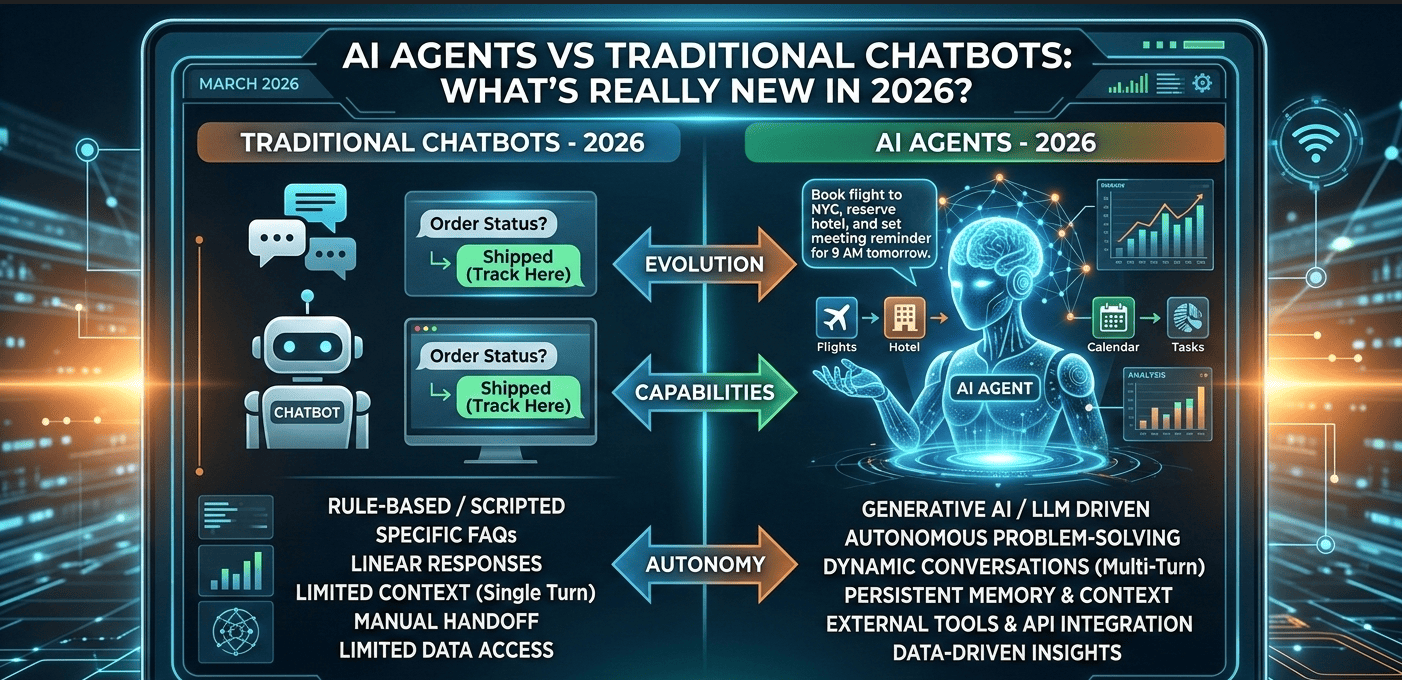
The big change in AI in 2026 is that now AI agents are truly able to perform tasks without needing a human in the middle, whereas traditional chatbots simply respond to the user from the chat window. Traditional chatbots are helpful too but generally speaking they will mainly stay within the confines of the chat window and do not complete multi-step processes completely. If we take the example of traditional chatbots, they have been designed mainly for Q/A or the ability to go through a menu of options. When you ask a question the chatbot looks for keywords in your question that it has already defined and creates a script to send back a response or link. Traditional chatbots are reactive - they wait for the user to say something to give them a reason to respond; if the conversation goes off of the "happy path" (the pre-defined script), or requires a user to have judgement or use information from many different systems they generally have great difficulty continuing to respond. During the cases of customer service, for example, with traditional chatbots they may be able to answer frequently asked questions, check on an order status, and then they escalate that issue directly back to a human agent.
The other major difference between AI agents and traditional chatbots is that AI agents are goal-oriented. You tell an AI agent the goal you are trying to accomplish (i.e., "provide a customer with a fair refund," "onboard a new employee," "create a follow up plan for a sales lead") and the AI agent will take that goal and analytically break it down by all the steps you'll need to take to achieve that goal, identify the most appropriate tools or API's to execute those actions, and determine what action should be taken next. Lastly, as compared to traditional chatbots, which only rely on keyword lookup for matching, AI agents use advanced reasoning, planning and memory to record their ongoing interactions with the business, including tracking their ongoing use of multiple systems.
Chatbots were never designed to drive execution at scale. They belong to an earlier era of conversational AI. Autonomous AI agents, on the other hand, represent a new paradigm focused on doing rather than discussing. In this year, this shift transitions from a frontier experiment to a mainstream operating model that reshapes how value is created, processes are run, and competitive advantage is earned. ExpertCallers supports this transition by enabling outcome-driven AI workflows with built-in human oversight where it matters.
AI Agents vs Traditional Chatbots: What’s Really New in 2026?
💼 Ready to Find Your Dream Job?
Browse verified fresher jobs and internships — updated daily.
Browse Latest Jobs →